Wednesday, October 04, 2006

A night on the lagoon

As we boated out to our campsite Tuesday afternoon, we surprised a group of at least 3 manatees in an open channel. The water literally erupted around the boat, and even though I had a camera in my hand, I was so stunned (and was also trying to count any noses or tails) that I didn’t get a picture. Unfortunately there was a strong wind and we didn’t have an anchor, so the boat drifted away quickly. We tried slowly moving back to the area, but they were either gone or sitting tight on the bottom (water was 7 meters deep there). Interestingly, nearby Pierre showed me some seagrass that he says grows throughout the lagoon, and that he says manatees like. No surprise there, but the surprise is that there is seagrass at all. There is almost no scientific literature on seagrass in West Africa, mostly because there isn’t much. So I collected a sample (photo below).
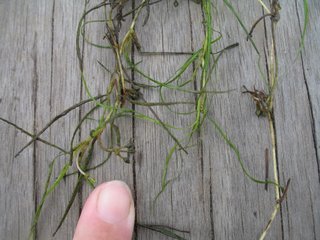
Manatee salad
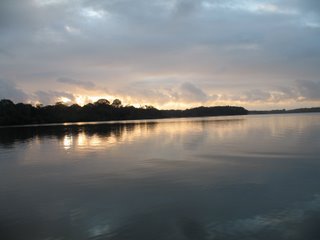
Sunset on the lagoon


We camped at Pierre’s family’s fishing camp (really just a cleared area in the forest) and did a night survey. We had a third sighting of a manatee in one particular small cove, which is the type of thing I’m looking for. Repeated sightings in the same place suggest frequent use, and therefore might be a good place to set nets to capture a manatee if we get funding to tag them here in the future. Which is something I really hope to do!

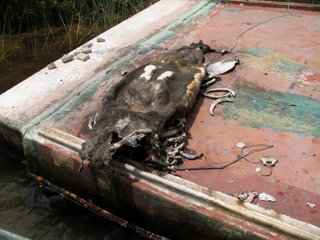
The net below is used for hunting manatees (called a Tangle net, because the mesh size is big and the manatee gets it’s head and flippers caught, tangles itself up and can’t escape), and is one of 5 such nets confiscated from the lagoon by the park EcoGuides here. It would be great to use it for a good cause- to catch manatees alive so that they can be GPS tagged and we can learn more about their behavior and distribution (where they go to find food, rest, day vs. night, dry vs. wet season, help us to get a baseline abundance estimate, etc).
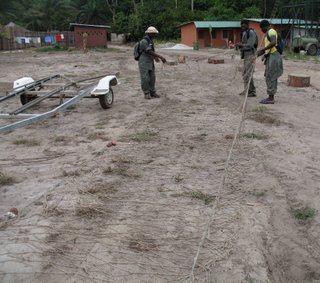
Pierre (in the hat) and Brice (in yellow) check out the confiscated manatee net
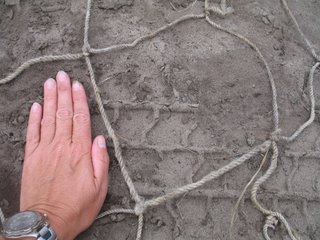
Communication Gap

Yesterday afternoon I headed out on the lagoon with my 2 EcoGuides, Pierre and Brice. They knew I had done an interview in the morning, describing my manatee research here and showing / describing the parts of a West African manatee skull (Tim recovered a skull from a carcass here in July, it is in pristine condition). So as we’re heading out from the lodge the guys say, “So, do you want to see another carcass?” I look at them in shock and they boat me over to a manatee carcass that is literally within sight of the lodge! Granted it wasn’t fresh, infact it had been recovered last Christmas Day, 2005. It has baked in the sun for all these months and is now basically dried hide over a complete skeleton. I had been given a brief report about this carcass shortly after I arrived at Iguela (basically 2 pictures and GPS coordinates), but no one had ever mentioned that they actually still HAD the carcass! When the guys saw that the other skull was important enough for me to describe to a camera crew, they realized I might be interested in other bones as well. Previously they had assumed I was only interested in live manatees. So now I wonder what else they will show me!

And so now there’s a second carcass to collect samples from- dried skin for genetics, earbones for aging, pelvic bones which are differently shaped in males vs. females. I’ll take some measurements (total length won’t be completely accurate, but it’s better than nothing), and see if we can store the bones out of the sun. It would be great to find a way for the skeleton to be re-articulated somewhere here where Gabonese people can see it.

This may not look exciting to many of you, but given how few complete West African manatee skeletons there are for education and scientific study, this is a gold mine!
By the way, I know my manatee friends in FL will laugh because it seems that no matter how hard I try to work with live animals, I always seem to end up dealing with the dead stuff!

Tuesday, October 03, 2006

For new bloggers...

If you want to go back to the beginning and see earlier posts, click on Septmber 2006 on the right side of this webpage. Posts are archived each month.

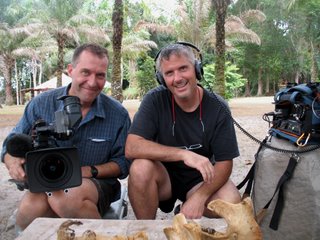
This morning I was interviewed by National Geographic for a documentary they're doing on Gabon's national parks. They hope to come out to the field with me later in the week. This was my view of Gil and Brian as I described the parts of a West African manatee skull. They are great fun!


I'm heading out to camp on the lagoon so I'll post more in a few days!

Monday, October 02, 2006

Some Iguela pictures


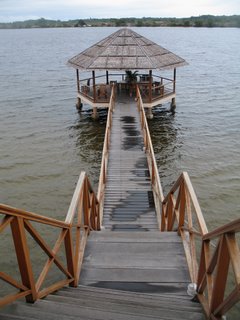
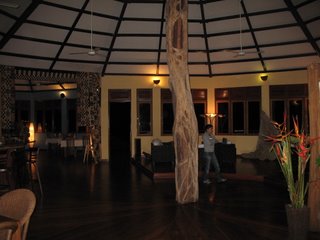
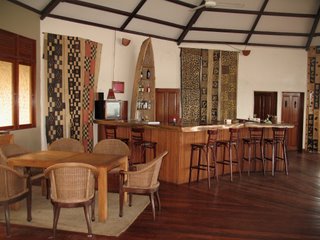
The main building. Guest dining room is on the left, salon area on the right. The bar and staff dining area (convienently near the bar!) is below. The gazebo out on the lagoon. The scientist's quarters, very comfortable!
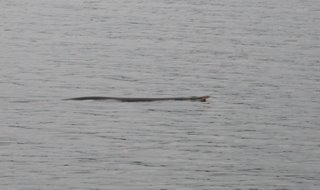
Snake swimming on the lagoon. It was about 3 feet long. I am not sure of the species, it wasn't in the reptile book here. Anyone have any ideas? Click on the photo to enlarge it and see the markings on it's head.
Answers to your questions

I’ve been getting a few questions from people over email, so here are some answers:

- What am I eating?

There’s African food and European food. Most days I eat European because that’s what is served to me. Heavy on the meat (chicken steak, pork) and potatoes, with occasional salad, green beans or peas. Pasta, lasagna. French bread is served at every meal. In Libreville I’ve had good Middle Eastern food twice (hummus, falafel) and Tim took me to a really good pizza restaurant. Good chocolate, bread and coffee can be found anywhere, so I’m happy.
The serious luxuries are cheese and yogurt. Here at Iguela, fruit is a luxury.
I’ve tried a few African foods- most notably baton de manioc, which is cassava root that is soaked in water for a few days then mashed up and shaped into a fat stick about a foot long. It’s white and rubbery but doesn’t taste too bad, kind of like congealed cream of wheat. It’s a staple here. There’s also feuille de manioc, which is the leaves of the plant mashed and cooked up, usually with spicy fish. It’s pretty good, somewhat like spinach. Other staples are plantains (yummy in every form!), hot peppers, sardines in tomato sauce, rice. I won’t be trying bushmeat, but a couple people have told me crocodile is very good when it’s cooked right.

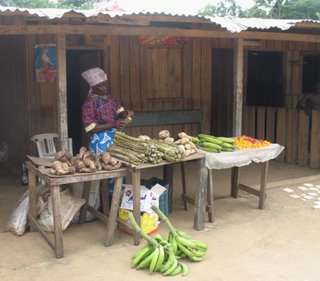
This lady is selling local produce in Kango. The batons de manioc are in the middle, wrapped in green leaves. On the left side are cassava roots (like potatoes), on the right are potatoes, plantains and peppers.


- What am I drinking?

Bottled water, a wonderful grapefruit soda called D’jino and Regab, the very good local beer. (Simon, I tried to post your wonderful pic of the beers at sunset in Mayumba, but it won't load!)

- Am I speaking French?

As best I can! My childhood French teacher would probably cringe in horror, but I’m re-learning alittle more every day and I can understand most conversations as long as people don’t speak too quickly. When I’m in Libreville (I’ve been there for a day or two between visits to study sites) most of the WCS people speak English (many are British or Dutch and there’s a couple Americans) and here at Iguela most of the people who run the lodge are Dutch and speak English, but for the most part all the guys I spend days in boats with only speak French.

- What’s the weather like?

Grey and misty rain mostly. I wish the rainy season would hurry up and start because I’d rather have heavy rain followed by clear skies, but I’m not really complaining… hippos look just as cool in the rain!


View of Fernan Vaz Lagoon as I flew to Iguela on Friday. The Atlantic Ocean is at the top of the picture on the far side of the slender peninsula. I also saw a group of humpback whales from the plane!


Iguela

Last Friday I flew from Libreville to Port Gentil and on to Iguela, which sits on Ngowe Lagoon about halfway down the coast of Gabon. It is also the site of Loango National Park, which you might’ve read about in National Geographic when Mike Fay did his Mega-transect walk across Africa a few years ago. This is where he came out on the coast and saw the hippos surfing in the ocean. I actually flew to the town of Ombooue, and from there we were picked up by a truck which drove us an hour an a half south across the savanna to Iguela. It’s a bumpy ride but you sit on these comfortable benches on the bed of the truck with a cover overhead and what amounts to rollbars along the sides, so it’s as comfortable as you can be while sliding up and down on sandy paths.

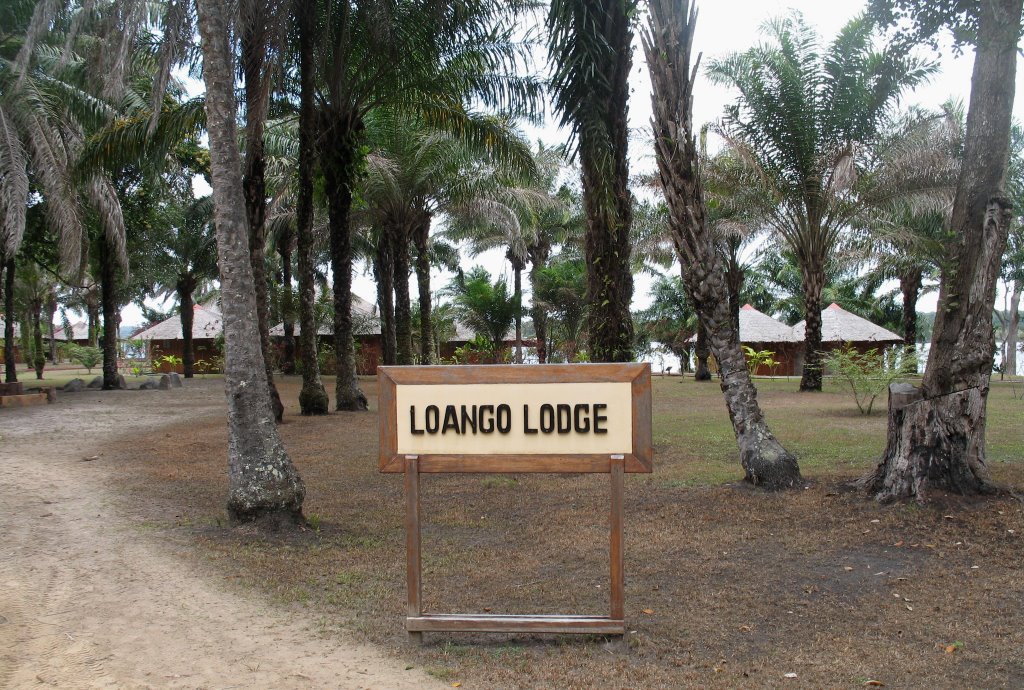
Loango Lodge is gorgeous and sits on a narrow part of the northern end of the lagoon. There are about 20 guest cabins, a main building with a library, bar, dining room and deck overlooking the water, a gazebo out over the lagoon and park offices. Guests come here to see the wildlife and fish. There are also staff and scientist quarters, so the whole place amounts to a village of about 60 people. The lodge is owned by a Dutchman named Rombout Swanborn, and his company, SCD, is a partner in Operation Loango, a joint venture initiative that comprises SCD (Société de Conservation et de Dévelopment), Wilidlife Conservation Society and the Gabonese National Parks Authority. The park is run by Gabon’s Ministry of Water and Forests with technical assistance from Wildlife Conservation Society. Tomo Nishihara is in charge of WCS’s program here. Scientists come here to study the plants, crocodiles, whales and now manatees! I was invited here by Tomo and Mr. Swanborn to assess the lagoon’s manatee population. Over the past few years Tim, Nic and others here have had quite a few manatee sightings, including a mating herd of 16 animals on one occasion. It could be another good location to do some satellite tagging in the future. There is still hunting here- the park staff (EcoGuides) have confiscated 5 manatee nets and also rescued and released a live juvenile manatee caught in a net.

Two EcoGuides have been assigned to work with me on the lagoon. Pierre is a former manatee hunter who now works for the park (former hunters make great park rangers because they know the area and how the poachers think, where to find all the animals, etc. And they make a living from protecting the wildlife instead of killing it). My other guide is Brice, he speaks alittle English which is helpful. My French is getting better since most people here don’t speak English, but I still think I need to buy some French language tapes when I get home since most of my vocabulary revolves around boats, plants, manatees and food (because you all know how important food is to me!).

On my first morning on the water on Saturday, we saw 3 manatees in 3 different locations, which was exciting. I now understand why there are almost no photos of West African manatees- you see them as they swirl away and that’s it. We also saw hippos, and a snake swimming across the lagoon. After I initially do some larger surveys of the lagoon, I’ll likely focus on 3 areas where manatees are most frequently seen: the northern corner of the lagoon (appropriately nicknamed Manatee Corner) and 2 rivers off the lagoon. Since the lagoon is over 20km long, the plan is to spend a few nights camping at each of these spots.
More on the Mamiwata Legend

As I explained earlier, Mamiwata is a general name for a spirit embodied by the manatee, that people in many West African countries believe in. In different regions there are different interpretations of what the spirit looks like and what acts it performs. Because she is female, it’s believed Mamiwata is looking for a husband, and tries to lure men into the water. I heard one story that she takes men below the water and chains them up so that she can keep them for herself. In Lambarene (and other parts of Gabon), I learned that people believe Mamiwata is a white woman with long blond hair. Since I was the only woman for probably 100 miles who fit that description, Nic joked that I was actually Mamiwata. While Nic and I were at Evaro we spoke to a man who was certain he had seen Mamiwata one night, when he was in his boat paddling across the lake back to his village. He said she rose completely out of the water until she was standing on top of the water alongside his boat. He was very serious about it and seemed a bit fearful of the event. It’s interesting to me how well this myth fits in with stories from all over the world of sirens (which mostly, but not always, refer to manatees), who lure sailors into the water.