Friday, May 30, 2008

Oil Spill News from Gabon

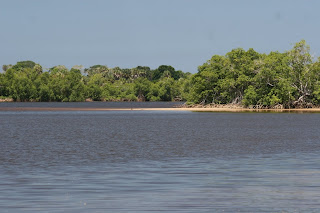
Below I've pasted an article posted on Bloomberg.com. The lagoon is actually named Fernan Vaz (also known as N'komi) and is the only lagoon in Gabon that is not part of a national park or protected area (and unfortunately it's also the only lagoon I haven't surveyed for manatees yet, although I hope to get there next Fall). The spill occurred at the southern end of the lagoon, at almost the furthest point from it's outlet to the ocean (which is obviously good for the ocean, but bad for the lagoon and its wildlife). There is little information so far on the effects of the spill.


Perenco Pipeline Burst May Have Caused Gabonese Oil Spill
By Clare Spencer

May 27 (Bloomberg) -- A pipeline operated by Perenco SA, a closely held French oil company, may have burst and caused an oil spill in a lagoon off the coast of Gabon, said Bas Huijbregts, a technical adviser to the World Wildlife Fund.

The spill occurred in the Ferna Naz lagoon near Omboue, 228 kilometers (142 miles) south of the capital, Libreville, on May 12, Huijbregts said in an interview today in the city. While the pipeline has subsequently been repaired, residents have been told not to drink the water, according to the Web site of Publish What You Pay, a Gabonese non-governmental organization.

No one was available for comment when Perenco's office in Libreville was contacted, said Magali Bechade, a personal assistant at the company.

Perenco pumps 50,000 barrels of oil a day in Gabon, according to its Web site. Gabon is sub-Saharan Africa's fifth-biggest oil producer and produced 232,000 barrels a day in 2006, according to the BP Statistical Review. Nigeria is the continent's biggest crude producer.

Map for reference (dark green areas are national parks):
And Another!
Today Disney Conservation Fund joins the list of Gabon manatee project funders with a new grant. I couldn't be happier about the momentum this work is gaining. I'm looking forward to giving a talk about African manatee work at Disney's Living Seas in July.

I still have a way to go to reach my ambitious budget goal that will allow me to GPS tag West African manatees for the first time, but every piece certainly helps!!

Thursday, May 01, 2008

A New Funder for Gabon!


Great news today, the SeaWorld Busch Gardens Conservation Fund has just notified me that they have awarded me a grant for my Gabon manatee research! This is a new funder for this project and it's the first funding I've received this year for the next round of work in Gabon. So I'm thrilled!! I am still waiting to hear about 7 other applications, but we're off to a good start.

Sunday, April 20, 2008

The Sirenian Population Genetics Workshop

Last Sunday and Monday I attended a sirenian genetics conference in Orlando put on by Bob Bonde and others from USGS Sirenia Project and University of Florida. It was a very successful meeting, not only to hear about ongoing work from around the world for both manatees and dugongs, but also because it wasn't too technical for those of us who are just getting involved with genetics. It is really impressive how far genetics work for manatees has come in the past few years. I gave a presentation on the collaborative effort I'm trying to set up for West African manatee genetics with folks from 11 countries in Africa (so far) and it was well-received.

Most of the conference group assembled for a photo. Hopefully another workshop will be convened in a couple years. (Photo courtesy of USGS)

Bonde was awarded a lifetime manatee conservation award which was really nice considering everything he's done for sirenians throughout his career. I don't have a picture of him receiving the award, so I'm posting this older photo taken a few years ago, which will give you an idea of his flair for fashion. Congratulations Bob!

Saturday, April 19, 2008

Angola Manatee Trip 1 Completed

I'm pleased with all the interviews and surveys we've accomplished in just under 2 weeks. I leave Soyo with a good undersatanding of the area, the excitement of seeing and photographing a manatee, great information from all the villages I visited, and good ideas for work to accomplish next time. I'm planning to return next summer, dates to be determined soon.
Thanks so much to everyone at Angola LNG for all the help (and quite a few laughs); Sheryl, Brian, Joao, Mike, Burt, Keren, Karen, Dave and the boat drivers in particular! And as always, thanks to Tim for providing good advice, constant humor and enthusiasm.

Here are a few more pictures, to give you a feeling for this place:

Huge container ships wait at the mouth of the Congo River because dock space at their destination ports is limited. The Congo River submarine canyon comes quite close to shore, allowing enormous ships to get very close to shore.

A boatload of empty gas drums on it's way downriver from Boma, DRC. The driver can't see where he's going, so another man is posted on the bow to help guide the boat.

Most local people still travel in canoes hand carved from a single tree
A few boats had homemade sails added

Boys playing
Kids loved my camera and begged me to take pictures continuously. Joao printed out copies to give to them on his next visit.

Palm Nut Vultures are common here and much more handsome than their American cousins.


And lastly, a gorgeous Baobab tree on the lagoon!

Tuesday, April 15, 2008

Sereia Peninsula

So far I've mostly been writing about my trips up the Congo River, and from the interviews I’ve done, manatees do seem to be sighted most often in the deep tributaries off the main river. However, at the mouth of the Congo is the Sereia Peninsula (sereia means mermaid in Portuguese!), which is made up of sandy beach, a few fishing villages and mangrove habitat criss-crossed with channels. I spent parts three days visiting villages and touring the mangrove waterways last week. The habitat is good for manatees and there are several stunning areas where huge mangroves overhang the waterway, creating sunlit tunnels.
The Sereia Peninsula juts northward at the southern mouth of the Congo River in the lower left of this Google Earth photo.

Mangrove cathedral
Atlantic Ocean view at a village called Etuba

Most villagers we talked to say that although they remember manatees being common here in the past, they are now rarely seen here. Several people told us that they knew of manatees found dead in fishing nets about 2 years ago, and another man reported finding a fresh dead manatee with a large propeller cut when he went out to check his nets early one morning just over a year ago. Apparently there was an old manatee hunter here, but he died last year. And one man told me he has seen more manatees this year than in the past few. Infact, he claims he sees them fairly often and told me a place to go to watch for them during low tides. In the same area I suspect there may be some aquatic plants- it’s an open shallow section of one of the larger waterways (it resembles a lagoon more than a channel), so I hope to spend more time there during my next trip.

A village called Moita Seca I on the eastern side of the peninsula

An open shallow area where aquatic plants may grow and manatees are reported more recently
A Day of Drifting and the Manatee Hunter

On Sunday I went back up the Congo River, once again hoping to see manatees. By now I’ve started to get a pretty good sense of the area. We go up the main river for about an hour before turning off into a tributary.

Heading up the Congo River from the mouth, in the early morning calm

At the mouth of the tributary is an Angolan navy outpost where we check in. On Sunday a navy guy came over and excitedly told us they had just seen a manatee go by, heading up the tributary. So we motored up a short distance, turned off the engine and drifted, but we never saw it. The river was very deep, 17-22m. We headed upriver past Kibaka and returned to a village called Nzadi Caca. There are actually two villages across the river from each other, all built on large mounds of clam shells. Not surprisingly, the large freshwater clams are the main food and livelihood of the villages in this area. The men free dive as deep as 16m in the river to get the clams, which they tell me the manatees eat as well (they specified that manatees only eat rotten or baby clams, presumably because they can actually get them out of their shells). Clams have been found in manatee stomach samples from northern Africa, so it was interesting to hear it described here as well. Joao bought some clams from the village and I tried one… unfortunately the kindest way to describe the taste was salted sediment.

A village across from Nzadi Caca built on millions of clam shells
Skewers of clams being smoked at Nzadi Caca
Villagers at Nzadi Caca frequently see manatees and were very helpful in describing behaviors they observe. My fantastic translator Joao and I are on the back left, and Mike Carpenter from Angola LNG is also in back (photo credit goes to Mike!).

After leaving Nzadi Caca we drifted downstream for awhile, once again hoping to catch a glimpse of a manatee. But this day was a reminder that we had been incredibly lucky last Thursday, because we didn’t see any all day. However, today there were also a lot more motorized boats heading upstream, all filled with gas drums headed for the Congo.

On our way back down the main river to base, we passed the town where the manatee hunter lives. There were several fishing boats out in front, so we asked a fisherman if the manatee hunter was there. He said yes, he was a short distance away on another boat. He paddled over to us and we were able to interview him (with Joao translating). The manatee hunter is named Sebastian and he has lived in this village his entire life except from 1955-1958, when he was sent to India with the Angolan army. He is an old man now but still hunts both manatees and crocodiles. He showed us his harpoons and net and gave a lot of good information about manatees. Although it is depressing that he is killing manatees, these interviews have to remain completely non-judgmental if I’m going to gain trust and get good information. He does have some bones in his village and hopefully next time I will be able to convince him to let me take samples for genetics.

Sebastian and one of his harpoons. He uses one (with bouy attached) to initially harpoon and then follow the manatee, and he has another 2 harpoons to finish the job.
Fishermen display the manatee capture net.
Joao and I interviewing the manatee hunter (photo: Mike Carpenter)